

Choose Mann Travel NZ if you want a travel agency focused on comparing and booking New Zealand–India flights; choose Silva Travel if its written offer better meets your route, baggage and booking-support requirements. For 2026, the deciding factor is the itinerary and terms you receive, not the agency name alone.
- Mann Travel NZ suits travellers comparing New Zealand–India flights, particularly journeys connecting family and travel ties.
- For mann travel vs silva travel, compare matching itineraries and written booking conditions before choosing.
- Choose Silva Travel when its documented offer better matches your journey and support requirements.
- Neither agency earns a blanket win on baggage, refunds or changes without checking the specific booking terms.
Why this matters
A travel agency comparison is useful only when it helps you choose a workable booking. A flight arriving in the wrong Indian city, an inconvenient connection or unclear change conditions can outweigh an attractive initial offer.
Compare the journey first, the booking conditions second and the agency third. That order keeps your decision tied to what you need rather than a general claim about which business is better.
For your 2026 trip, prepare one brief and request 2 written quotes against it. Use the same departure city, destination, dates, passenger details and baggage requirements so differences are visible.
At a glance
The table separates a stated service fit from conditions you must establish for your own booking. A conditional recommendation is not a claim that either agency always provides better fares or service.
| Dimension | Mann Travel NZ | Silva Travel |
|---|---|---|
| Best for | NZ travellers seeking an agency focused on flights to India | Travellers whose written Silva Travel offer better fits their requirements |
| Route fit | Stated focus includes Auckland, Wellington, Christchurch and Queenstown to Indian cities | Choose when the proposed itinerary better matches your actual journey |
| Standout feature | Explicit New Zealand–India flight comparison and booking focus | A stronger individual proposal, when demonstrated in writing |
| Booking continuity | Compare against any existing trip arrangements before switching | Preferable when retaining an existing suitable booking avoids unnecessary disruption |
| Baggage clarity | Assess the allowance on the proposed ticket | Assess the allowance on the proposed ticket |
| Changes and refunds | Request the applicable airline conditions and agency terms | Request the applicable airline conditions and agency terms |
| Pricing model | Assess an itemised booking quote and any separately stated service charges | Assess an itemised booking quote and any separately stated service charges |
| Hotel planning | Hotel bookings are also part of the stated services | Include hotel arrangements only when they appear in the written proposal |
Mann Travel NZ has the clearer stated NZ–India route fit
Mann Travel NZ is a practical fit for New Zealand travellers seeking agency help comparing and booking flights to India. Its stated service covers departures from Auckland, Wellington, Christchurch and Queenstown, with Indian destinations including Delhi, Mumbai, Amritsar, Ahmedabad, Bengaluru, Hyderabad, Chennai and Kochi.
That scope gives you a concrete starting point. You can describe where you live, where you need to arrive and whether your plans include a hotel booking, rather than beginning with a broad destination search.
The limitation is equally clear: a stated route focus does not establish the best itinerary for every passenger. It does not prove a particular airline, baggage allowance, connection or booking condition is included.
- Best for: travellers who want help comparing NZ–India flight options against a specific journey.
- Advantage: the stated service aligns directly with that booking task.
- Trade-off: you still need a written proposal to judge the actual flights and conditions.
Ask for your intended arrival city first. If another gateway is proposed, assess the onward journey before treating it as an equivalent option.
Silva Travel wins when its proposed itinerary fits better
Choose Silva Travel when its written itinerary better satisfies your non-negotiable travel requirements. That is a genuine reason to choose a competing agency, even when another provider has a clearly stated destination focus.
For example, compare which proposal reaches your intended Indian city, accommodates your travel dates and gives you acceptable connections. These are decision criteria, not assumptions about what Silva Travel offers.
A proposal deserves preference when the difference is useful to you. An earlier arrival matters if it fits a fixed family commitment; a different airport does not help if it creates an onward journey you want to avoid.
- Best for: travellers holding a Silva Travel proposal that is a better match for their specific trip.
- Advantage: a demonstrated itinerary benefit is more useful than a general brand preference.
- Trade-off: a better schedule alone does not settle baggage, change or cancellation questions.
For a 2026 departure, compare the complete outbound and return journeys. Do not choose on the stronger outbound option while overlooking an unsuitable return connection.
Silva Travel is the better choice when continuity matters
If you already have a suitable Silva Travel booking, keep it unless an alternative provides a clear benefit after the existing conditions are considered. Changing agencies is not an improvement by itself.
Start by establishing whether you hold an enquiry, a reservation or an issued ticket. Before replacing anything, ask what happens to the original arrangement and whether cancellation or amendment conditions apply.
This is particularly relevant when flights form part of a larger plan. Your airport pickup, leave dates and onward arrangements all need to remain consistent with the final itinerary.
- Best for: travellers with an existing suitable booking and no specific problem to solve.
- Advantage: keeping a workable arrangement avoids replacing it merely to change provider.
- Trade-off: continuity is not a reason to accept an itinerary that no longer meets your needs.
Apply the same rule to either agency. If your current booking works, require a concrete reason before making a change.
Neither agency wins on baggage without the ticket conditions
Treat baggage as a ticket-level comparison, not an agency-level promise. Ask for checked baggage and cabin baggage details for the flights in each proposal, including any connecting sectors.
An allowance described only as baggage included is not detailed enough for a careful comparison. Request the weight or piece allowance, relevant restrictions and any collection or recheck instructions that apply to your journey.
This matters when your itinerary combines different flights. Establish what happens to your bags at each connection rather than assuming the arrangement is identical throughout.
Use these 3 checks:
- Allowance: what checked and cabin baggage does the quoted ticket include?
- Connections: where must you collect or recheck your bags?
- Exceptions: do any sectors have different baggage conditions?
Neither proposal is ready for approval until you understand those answers. If an agency explains a restriction clearly, assess the restriction itself rather than rewarding reassuring wording.
Neither agency wins on flexibility without written terms
A flexible booking is useful only when you understand what can change and under which conditions. Ask both agencies to separate airline fare rules from their own service terms.
For date changes, establish whether changes are permitted, whether a fare difference applies and whether an agency charge applies. For cancellations, distinguish a refund to the original payment method from a credit or another arrangement.
Also ask who you contact after booking. A clear contact process is useful; an unverified claim about faster support is not a basis for choosing.
Before approving a 2026 booking, get written answers covering:
- Changes before departure and after travel has started.
- Cancellation conditions and the form of any eligible refund or credit.
- Missed-flight conditions and any relevant restrictions.
- The process for dealing with an airline schedule change.
- The agency contact route for booking amendments.
The winner is the proposal whose conditions fit your risk tolerance. If your dates are fixed, you might accept tighter conditions; if your plans are unsettled, assess flexibility before committing.
Pricing: compare the complete booking, not a headline offer
For flight-booking services, compare the amount attached to the actual itinerary and the charges that apply to optional or later actions. Do not treat an initial quote as a complete explanation of the booking model.
Request an itemised proposal that identifies the flights, inclusions and any separately charged agency services. Ask whether changes or cancellations involve charges beyond the airline's own conditions.
The trade-off is predictability versus the conditions attached to your choice. A restrictive ticket can suit fixed plans, while a different fare structure can suit a traveller who needs more room to change dates; neither is automatically better.
Use the same currency and matching inclusions when comparing 2 quotes. If one proposal includes something the other excludes, resolve that difference before deciding which represents better value.
Avoid a blanket cheaper-agency verdict. Your decision concerns the booking offered for your journey, not a permanent ranking of the businesses.
Use one brief to make the comparison useful
A consistent request makes differences easier to spot. It also prevents you from comparing proposals based on different assumptions.
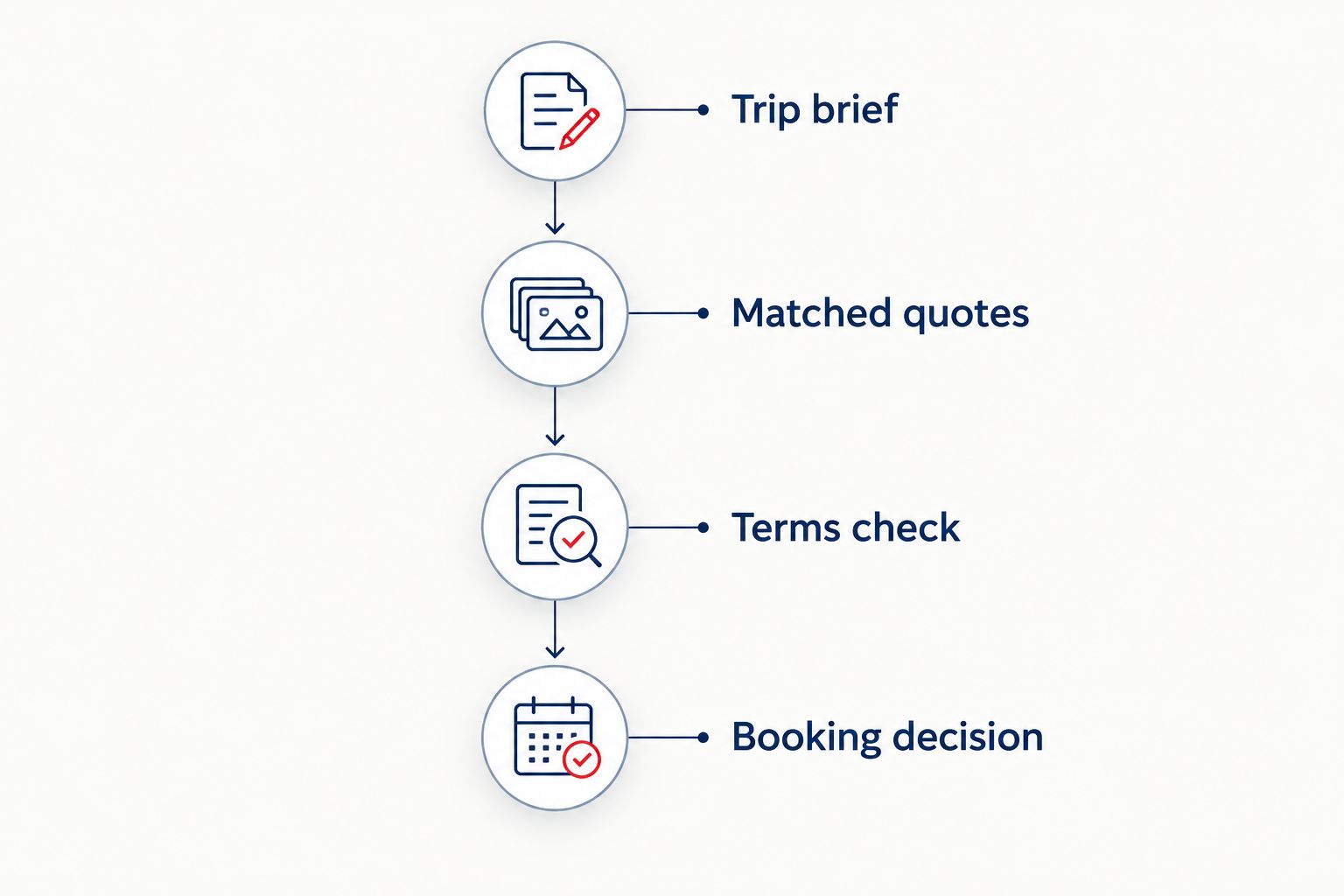
Follow this sequence for your 2026 trip:
- Trip brief: state departure city, final destination, dates, passengers and baggage needs.
- Matched quotes: request written proposals based on that same brief.
- Terms check: review baggage, connections, changes, cancellations and agency responsibilities.
- Booking decision: choose the proposal that meets your requirements without unresolved conditions.
Keep your requirements separate from preferences. An arrival deadline is a requirement; a preferred connection airport might be negotiable. Mark the difference so an alternative itinerary can be assessed fairly.
When you are ready to request a proposal, use the contact page and include your complete trip brief. Ask for unresolved points to be answered in writing before you authorise a booking.
Final verdict: choose the proposal that solves your trip
Choose Mann Travel NZ if you need NZ–India booking help
Best for: New Zealand travellers seeking an agency whose stated services directly match flights to India. This includes travellers planning departures from the named New Zealand cities and arrivals in the Indian cities covered by its service description.
Choose this option for its relevant service focus, then assess the proposed itinerary on its merits. Hotel booking is also within the stated offering, but request the details rather than assuming a combined arrangement.
Choose Silva Travel if its documented offer is the better fit
Best for: travellers with a stronger written proposal or an existing suitable Silva Travel booking. Choose Silva Travel when the practical advantage is identifiable in the itinerary, conditions or continuity of your arrangements.
Do not require a competitor to lose every category to justify your choice. A single non-negotiable requirement can decide the booking when the rest of the conditions are acceptable.
| Dimension | Winner |
|---|---|
| Best for | Match the agency to your traveller profile |
| Stated NZ–India route fit | Mann Travel NZ |
| Standout feature | Explicit route focus for the client; Silva Travel if its actual proposal fits better |
| Booking continuity | Silva Travel when an existing suitable booking should be retained |
| Baggage clarity | No default winner; compare ticket conditions |
| Changes and refunds | No default winner; compare written terms |
| Pricing model | No default winner; compare complete, itemised proposals |
| Hotel planning | Client's stated service includes hotel bookings; compare any proposed arrangements separately |
FAQ
Is Mann Travel NZ better than Silva Travel for flights to India?
Mann Travel NZ has an explicit New Zealand–India flight comparison and booking focus. Choose Silva Travel instead when its written itinerary and conditions better meet your specific requirements.
Which agency should I choose for a family visit to India?
Choose the agency whose proposal reaches your intended destination on suitable dates with acceptable baggage and booking conditions. Give both agencies the same passenger and journey details before comparing their offers.
Does Silva Travel have better baggage allowances?
Compare the allowance on the proposed ticket rather than assuming an agency-wide advantage. Ask for checked baggage, cabin baggage and connecting-sector conditions in writing.
How do I compare the total cost of agency bookings?
Request matching, itemised proposals in the same currency. Check the included services and any separately stated agency charges before deciding which booking represents better value.
Should I change agencies if I already have a booking?
Keep a suitable existing booking unless an alternative offers a clear benefit after the original booking conditions are considered. Establish whether your current arrangement is an enquiry, reservation or issued ticket before replacing it.
What should I ask about refunds before booking?
Ask whether the proposed ticket permits cancellation and what form any eligible refund takes. Request the airline conditions and the agency’s own cancellation terms separately.
What information should I send for a 2026 flight quote?
Send your departure city, destination, travel dates, passenger details and baggage requirements. Identify any fixed arrival deadline, preferred connections or hotel-booking needs so the proposal addresses your actual trip.
One last thing
Compare the flight numbers before comparing the agency names. If the proposed flights match, turn your attention to ticket conditions, inclusions and agency responsibilities; if they differ, decide which journey you actually want first.
That simple check keeps an agency comparison from hiding an itinerary comparison. Save the final written proposal alongside your booking confirmation so you have a clear record of what you accepted.
Related guides
- Silva Travel alternatives for NZ–India flights
- Skyscanner alternatives for NZ–India flights
- Family holiday destinations in India for Kiwi travellers

