

International students’ NZ to India flight planning is choosing flights around study dates, entry requirements and baggage needs to protect your return to classes. This 2026 guide explains how to compare journeys, check ticket conditions and organise documents before booking.
- For NZ to India flights for international students, compare complete itineraries, baggage allowances and change rules.
- Mann Travel NZ is best for international students seeking agency help comparing NZ to India flights.
- Student status does not automatically include extra baggage or flexible ticket conditions.
- Check transit requirements and New Zealand re-entry conditions before paying for your journey.
Why flight planning matters for international students
A trip home has to fit around more than departure and arrival dates. Your exam timetable, accommodation arrangements and return-to-study obligations all affect which itinerary works. A flight that reaches New Zealand before classes begin still needs to leave time for your onward journey to campus.
For 2026 travel, build your comparison around the dates you can actually leave and return. An academic calendar is a starting point, not confirmation of your individual assessment schedule. Check compulsory placements, practical sessions and any assessments scheduled outside normal teaching weeks.
Mann Travel NZ compares and books flights from Auckland, Wellington, Christchurch and Queenstown to Indian cities including Delhi, Mumbai, Amritsar and Ahmedabad. Agency assistance is useful when you want help comparing routes; you still need to confirm your own study obligations and immigration conditions.
Choose the itinerary that fits your complete trip, not simply the flight with the most convenient departure. Record the conditions beside each option so you can compare like with like.
How to plan your student trip to India
Confirm your study dates before searching
Start with your institution’s academic calendar, then check your course timetable and assessment notices. If your final exam date is not confirmed, do not treat the end of teaching as permission to leave. Ask your programme team about attendance requirements before committing to travel.
For your 2026 trip, write down your earliest acceptable departure and latest acceptable arrival back in New Zealand. Include the journey from the arrival airport to your accommodation. Arriving in Auckland is not the end of the trip if you study elsewhere.
Test 2 return dates as a planning exercise: your preferred date and an earlier alternative. Compare the practical difference without assuming that a particular weekday has better fares or connections.
- Confirm exams, placements and compulsory attendance before choosing dates.
- Include domestic transport at both ends of the journey.
- Check accommodation access if you return outside normal reception hours.
- Keep written confirmation of any approved absence with your travel records.
Compare itineraries
Use airline websites and a simple spreadsheet to compare 3 itineraries against the same requirements. Search the same dates, destination and baggage needs each time. A comparison becomes misleading when one result includes checked baggage and another does not.
Compare Auckland, Wellington, Christchurch or Queenstown departures according to where you live, rather than assuming a different departure city saves effort. Include any positioning flight, airport transfer or overnight stop in your assessment.
The useful question is whether the whole journey works, including what happens between flights. Record the following fields before deciding which option deserves a closer look.
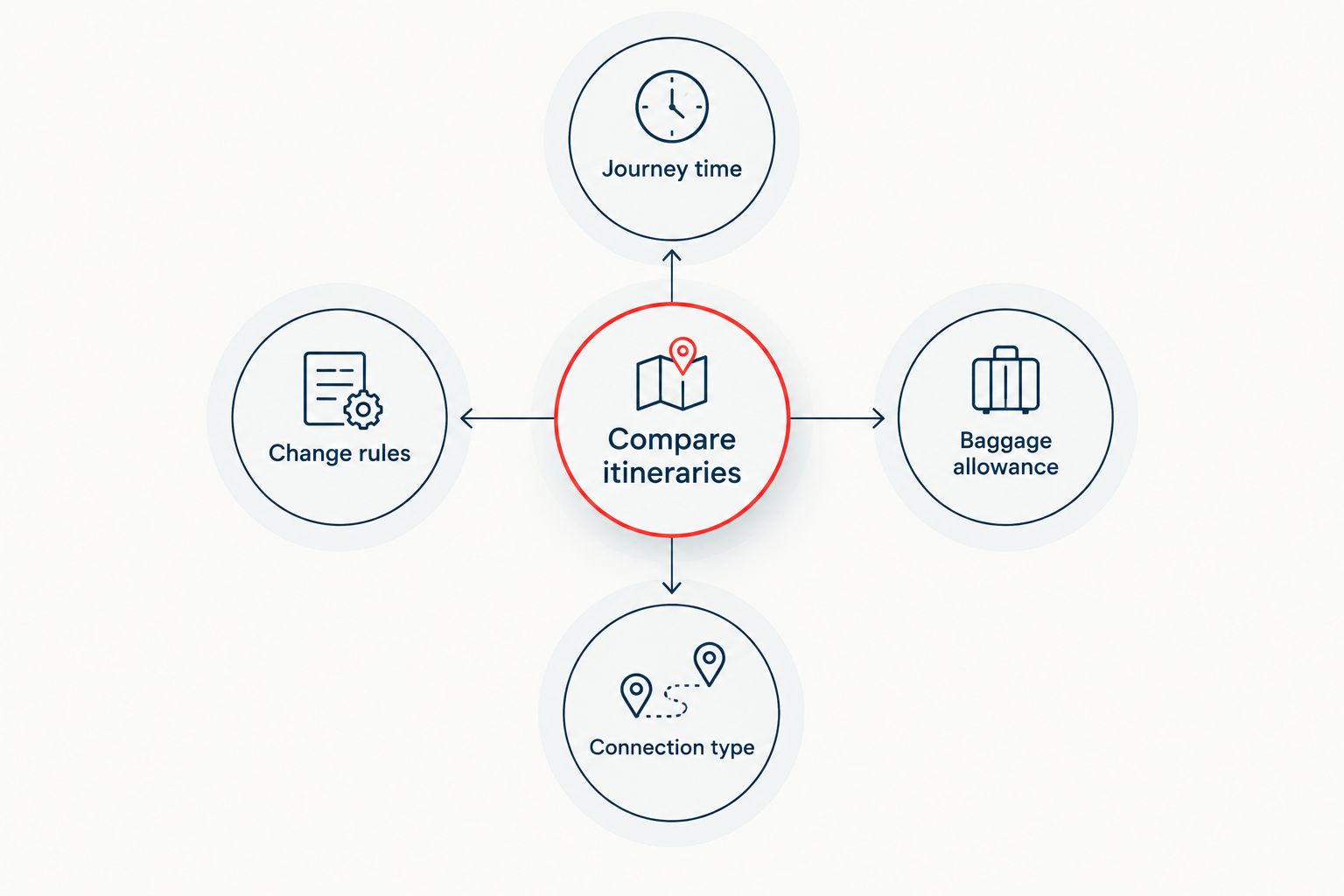
- Journey time: record departure, arrival, date changes and time spent between flights.
- Baggage allowance: record checked and cabin baggage for every sector.
- Connection type: identify through-ticketed journeys, separate tickets and airport changes.
- Change rules: record amendment conditions, refund restrictions and the booking contact.
Ask for a comparison using your actual requirements
You can read fare conditions yourself and build a shortlist without agency assistance. Keep the itinerary details together, including operating airlines, connection airports and the baggage shown for the selected fare. Search results alone are not a complete booking record.
Mann Travel NZ compares and books NZ to India flights, giving students an agency route alongside self-service searching. To make the discussion useful, send a clear brief rather than asking only for a student ticket. You can contact the agency with your departure city, destination, dates and baggage needs.
Ask for the relevant conditions before accepting an option. Agency assistance does not change an airline’s ticket rules or establish your eligibility for a student-specific offer.
- State your departure airport and final destination in India.
- Separate fixed travel dates from dates you can change.
- Explain checked-baggage needs and any equipment you intend to carry.
- Ask who handles changes after ticketing and which conditions apply.
Check passports, entry conditions and transit requirements
Check documents before payment, not after choosing a route. Your passport nationality, immigration status and transit arrangements determine the checks you need. Studying in New Zealand does not, by itself, establish your right to enter India or pass through another country.
For a 2026 journey, use current official immigration guidance for India, New Zealand and every transit country. Match that guidance to the actual itinerary. An airside connection and a transfer that requires collecting baggage or changing airports are different arrangements.
Check the name on the reservation against your passport before the ticket is issued. If your passport or immigration circumstances will change before departure, resolve the implications before booking.
- Confirm passport validity requirements for the entire journey.
- Check Indian entry documents according to your nationality and status.
- Check transit requirements for each connection and airport transfer.
- Confirm that your New Zealand visa permits your planned return.
Read baggage conditions before packing
Read the allowance attached to the specific fare, not a general description of an airline’s service. Separate checked baggage from cabin baggage and check both weight and piece limits. A student label is not evidence of an additional allowance.
If you find a student-specific offer, check its eligibility and documentation requirements before relying on it. Ask whether the benefit appears on the issued ticket or booking confirmation. Keep that evidence with your itinerary.
Pack around the most restrictive applicable condition on your journey. A domestic sector or separately booked connection needs its own check, especially when you are carrying books, gifts or belongings for an extended visit.
- Check checked-baggage weight and piece limits on every sector.
- Confirm cabin-bag dimensions, weight limits and personal-item rules.
- Read airline and airport guidance for batteries, liquids and restricted items.
- Check New Zealand biosecurity requirements before packing food or other risk goods for your return.
Understand changes and missed connections
Read the amendment, cancellation and no-show conditions before accepting the ticket. A changeable booking is not the same as an unrestricted booking. Ask whether a date change involves a fee, a fare difference or both, and identify any conditions on when changes must be requested.
For your 2026 return, check whether the ticket remains suitable if an assessment, family commitment or document issue changes your plans. Do not assume you can simply miss a flight and use the remaining sectors. Ask how a missed departure affects the rest of the itinerary.
Separate tickets need particular attention because the onward booking has its own conditions. If disruption affects the first flight, do not assume the next airline will amend a different ticket.
- Save the fare conditions supplied before payment.
- Confirm whether connections are on one ticket or separate tickets.
- Identify who to contact for voluntary changes and disrupted travel.
- Read any travel insurance policy for relevant cover, exclusions and claim conditions.
Save your documents and recheck before departure
Create 1 offline folder containing your itinerary, ticket confirmation, relevant travel documents and booking contact details. Keep sensitive records secure and accessible without relying on an airport internet connection. A reservation reference is useful, but it does not replace the other documents you need.
Recheck flight details directly against your latest booking information before leaving for the airport. Look at local departure dates as well as times; an overnight departure is easy to assign to the wrong calendar day. Follow the airline’s check-in instructions for your itinerary.
Repeat the document check before your return from India. Your outbound journey does not confirm that every document remains valid for re-entry into New Zealand.
- Save ticket confirmations and the latest itinerary offline.
- Record booking contacts and operating-airline details.
- Check departure airports, terminals and local calendar dates.
- Reconfirm return-entry documents before leaving India.
Compare booking options for student travel
The best booking method depends on how much comparison and administration you want to handle yourself. These options describe different ways to arrange your journey, not different immigration rights or guaranteed student benefits.
| Option | Best for | Main advantage | Key limitation |
|---|---|---|---|
| Airline website | Students comfortable checking and managing an airline booking themselves | Lets you review the airline’s own fare conditions during booking | Comparing several airlines requires separate checks |
| Online booking site | Students building an initial shortlist across flight options | Brings different itineraries into a search process | You must check the seller, ticket conditions and who handles amendments |
| Mann Travel NZ | Students wanting agency help comparing and booking NZ to India flights | Provides a travel-agency booking option for New Zealand departures to Indian cities | Agency help does not replace personal document checks or remove ticket restrictions |
Whichever option you choose, compare the final itinerary and conditions before payment. A matching flight number does not establish that two offers have the same baggage, amendment or refund terms. Keep the selected fare details rather than relying on an earlier search result.
Common mistakes international students make
Booking before the exam timetable is confirmed
The end of lectures does not confirm the end of your academic obligations. Check your individual assessment schedule and compulsory attendance requirements before fixing your departure. If dates remain uncertain, examine the ticket’s change conditions rather than treating an unconfirmed date as final.
Assuming every student ticket includes extra baggage
Student status and baggage entitlement are separate questions. Check the offer’s eligibility requirements and the allowance recorded for the selected ticket. Do not pack against an advertisement that does not apply to your booking.
Treating a stopover as a document-free transfer
A connection can involve immigration formalities, baggage collection or an airport change. Check the actual transfer arrangement against official requirements for your passport and status. Do this before accepting the route, especially when combining separate tickets.
Planning only as far as the international airport
Landing in Delhi or Mumbai does not complete your journey if family lives elsewhere. The same applies when you return to New Zealand and need to reach a different city or campus. Include onward transport and any overnight stay in the original plan.
Leaving the return-entry check until the end
An outbound booking says nothing about your permission to return to New Zealand. Check your visa’s travel conditions before departure and again before the return flight. Resolve uncertainty through official immigration guidance rather than a flight search result.
FAQ
What should international students check before booking NZ to India flights?
Check study dates, passport and entry requirements, transit arrangements, baggage and ticket conditions before booking. Compare the complete journey, including transport between your airport and final destination.
Does a student ticket automatically include extra baggage?
No, student status does not automatically establish an extra baggage allowance. Check the specific offer’s eligibility requirements and the allowance recorded on your ticket or booking confirmation.
Can Mann Travel NZ help international students book flights to India?
Yes, Mann Travel NZ compares and books flights from New Zealand departure cities to Indian destinations. Give the agency your dates, destination and baggage needs, then confirm the conditions of the proposed ticket.
Do I need a transit visa when flying from New Zealand to India?
Transit requirements depend on your passport, immigration status, transit country and transfer arrangements. Check current official guidance for your exact itinerary before booking, including whether you must collect baggage or change airports.
Can I change my return flight if my study dates change?
Your ticket’s fare conditions determine whether and how you can change your return flight. Check amendment conditions, any applicable fee and fare difference, and who must process the request.
Is booking separate tickets a good option for students?
Separate tickets are an option only if you understand and accept the connection responsibilities. Check baggage collection, check-in requirements, transit documents and what happens to the onward booking if the first flight is disrupted.
What should I check before returning to New Zealand in 2026?
Confirm that your passport and New Zealand visa permit your planned return in 2026. Recheck your itinerary, baggage allowance and biosecurity requirements before leaving India.
One last thing
An overnight departure belongs to the date printed on the ticket, not the evening you start getting ready. Before arranging transport, read the local departure date and time together. Then work backwards using the airline’s check-in instructions.
Do the same for your return arrival. Send family or whoever is collecting you the full itinerary, including the arrival date, rather than a message saying only which day you leave India. This final check connects the flight booking to the practical arrangements that get you home and back to study.
Related guides
- Skyscanner alternatives for NZ to India flights
- Trip.com alternatives for NZ to India flights
- Mann Travel vs Flight Centre: which is better?

