
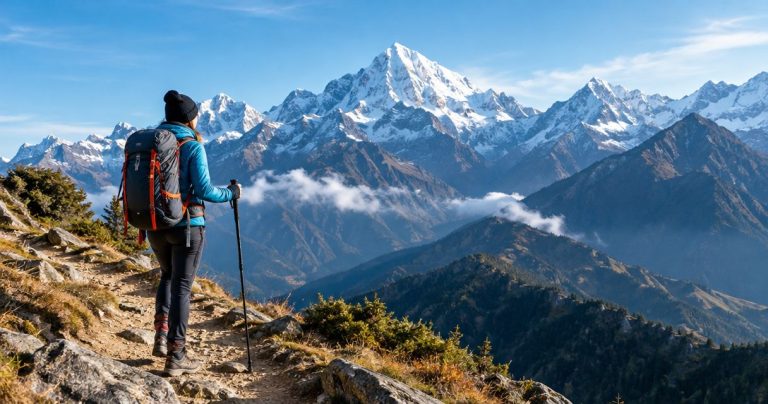
Best overall: Hampta Pass. Best for Himalayan panoramas without a high-pass crossing: Sandakphu. Best for alpine flowers: Valley of Flowers. This guide compares the best Himalayan trekking destinations in India for 2026, with practical advice on terrain, seasons and planning your journey from New Zealand.
- Hampta Pass leads the best Himalayan trekking destinations in India for contrasting landscapes on a high-pass trek.
- Choose Sandakphu for mountain panoramas; choose Valley of Flowers for alpine plants and a lodge-based approach.
- Markha Valley suits dry mountain scenery; Goecha La and Kashmir Great Lakes suit experienced mountain walkers.
- Mann Travel NZ books flights and hotels; confirm your trekking arrangements separately before fixing international travel dates.
Why this matters
A Himalayan trek is not just a destination choice. Your route determines the season, altitude exposure, road transfers and how much flexibility you need around your flights. A valley walk and a remote pass crossing require different preparation, even when both appear on the same shortlist.
Mann Travel NZ is best for New Zealand travellers arranging flights and hotels around an Indian Himalayan trekking holiday. Start with your trek dates, then compare your international journey through Mann Travel NZ. Keep the trekking operator’s arrival requirements separate from the airline itinerary: landing in India does not mean you have reached the trailhead.
What makes the best Himalayan trekking destination?
Use these criteria before choosing a route for 2026:
- Terrain fit: Match the walking surface, sustained climbs and exposed sections to your actual experience, not your general fitness alone.
- Altitude profile: Check sleeping elevations and ascent patterns. A summit or pass elevation tells only part of the story.
- Season fit: Choose the landscape you want first, then confirm when that particular route is suitable.
- Access: Account for domestic connections and mountain-road transfers as well as time on foot.
- Accommodation: Decide whether you want lodge-based nights or accept camping and limited facilities.
- Recovery margin: Leave room for weather disruption and a slower return rather than connecting straight to your international departure.
Best Himalayan treks at a glance
These rankings separate distinct travel goals rather than treating every trek as interchangeable. The order below matches the detailed recommendations.
| Destination | Best for | Standout feature | Key limitation |
|---|---|---|---|
| Hampta Pass, Himachal Pradesh | Contrasting landscapes | Crossing between Kullu and the Lahaul side | High-pass exposure and changing snow conditions |
| Sandakphu, West Bengal | Himalayan panoramas | Views towards the Kangchenjunga and Everest groups | Cloud can hide the main attraction |
| Valley of Flowers, Uttarakhand | Alpine flowers | A protected high-altitude flowering valley | Monsoon rain and fixed park access rules |
| Markha Valley, Ladakh | Dry mountain landscapes | Villages, broad valleys and high passes | Acclimatisation is essential |
| Goecha La, Sikkim | Close mountain viewpoints | A demanding approach towards Kangchenjunga | Significant altitude and permit planning |
| Kashmir Great Lakes, Jammu and Kashmir | Alpine lakes | A multi-day sequence of mountain lakes | Remote camping and changing regional conditions |
1. Hampta Pass: best Himalayan trek for contrasting landscapes
Hampta Pass connects the greener Kullu side of Himachal Pradesh with the more sparsely vegetated landscape towards Lahaul. The pass reaches approximately 4,270 metres, making altitude and snow conditions central to your planning rather than minor itinerary details.
Best for: Fit walkers who want a high-pass journey with a clear change in scenery. Hampta Pass is the default recommendation here because the landscape contrast gives the crossing a strong purpose beyond reaching an elevation marker.
Hampta Pass pros
- Forest, meadows and rockier mountain terrain create variety within one journey.
- Manali provides an established staging point for organising onward transport.
- The pass crossing gives the route a clear progression rather than repeated valley walks.
Hampta Pass cons
- Snow and weather affect the difficulty of the crossing.
- Camping and sustained climbing require more preparation than a hill-station walking holiday.
For 2026, ask your operator about current snow conditions, the planned sleeping elevations and the arrangements if the pass cannot be crossed. Do not treat an optional excursion beyond the trek as guaranteed: road conditions and your group’s progress determine what fits.
Verdict: Choose Hampta Pass for landscape variety; skip it if you want low-altitude walking or lodge accommodation throughout.
2. Sandakphu: best Himalayan trek for panoramic mountain views
Sandakphu lies on the Singalila ridge near the India–Nepal border. At approximately 3,636 metres, it offers a mountain-view objective without the same high-pass profile as Hampta Pass or Markha Valley.
Best for: Walkers who prioritise distant Himalayan panoramas and prefer an itinerary using local lodges where arranged. Clear conditions reveal the Kangchenjunga group and distant peaks in the Everest region; clouds remove that advantage entirely.
Sandakphu pros
- The ridge provides broad viewpoints rather than a single viewing stop.
- Lodge-based itineraries reduce dependence on camping equipment.
- Forest and rhododendron scenery add interest beyond the mountain skyline.
Sandakphu cons
- Visibility depends on weather, so no itinerary guarantees peak views.
- Road-accessible stretches make parts of the experience less secluded.
Ask exactly which sections you will walk and which involve vehicle transfers. Check border-related document requirements for your nationality and chosen route, rather than assuming that every itinerary follows identical arrangements.
Verdict: Choose Sandakphu for panoramas and lodge-based walking; skip it if remote wilderness is your main objective.
3. Valley of Flowers: best Himalayan destination for alpine flowers
Valley of Flowers National Park in Uttarakhand protects a high-altitude valley known for seasonal alpine plants. The valley lies broadly around 3,500–3,700 metres, so the floral focus does not remove the need to take altitude seriously.
Best for: Travellers interested in plants, photography and a walking trip based around Ghangaria rather than a camping traverse. The approach still includes sustained uphill walking and mountain-road travel.
Valley of Flowers pros
- Alpine plants provide a specific reason to choose the route.
- Ghangaria serves as a base for visiting the valley.
- The out-and-back structure avoids a remote pass crossing.
Valley of Flowers cons
- Flowering season overlaps with monsoon conditions, bringing rain and travel disruption risks.
- Visitors must follow park entry rules; camping inside the national park is prohibited.
For 2026, verify the announced opening period and local access before booking fixed travel. A guide describing peak blooms cannot promise the same display on your dates, because flowering varies with weather and location within the valley.
Verdict: Choose Valley of Flowers for alpine plants; skip it if dry trails and predictable road access are essential.
4. Markha Valley: best Himalayan trek for dry mountain scenery
Markha Valley is in Ladakh, where villages, exposed slopes and broad valleys create a different setting from the greener Himalayan routes. A commonly used itinerary crosses Kongmaru La, a pass above 5,000 metres.
Best for: Experienced walkers who want Ladakhi village landscapes and accept an acclimatisation-led schedule. Reaching Leh is the start of altitude preparation, not a signal to begin hard trekking immediately.
Markha Valley pros
- Village landscapes add a cultural dimension to the walking.
- The dry mountain setting contrasts sharply with forested Himalayan routes.
- Some itineraries incorporate homestays rather than camping every night.
Markha Valley cons
- High elevations require deliberate acclimatisation before and during the trek.
- Exposed terrain, river conditions and long walking stages demand preparation.
Check the exact route: different starting points and accommodation arrangements change the experience substantially. Ask how the operator handles river crossings, drinking water and an early exit, rather than judging the itinerary by its destination name alone.
Verdict: Choose Markha Valley for Ladakhi landscapes; skip it if your schedule cannot accommodate acclimatisation.
5. Goecha La: best Himalayan trek for close mountain viewpoints
Goecha La approaches the Kangchenjunga massif through Sikkim’s mountain forests and alpine terrain. Trekking itineraries commonly focus on a designated viewpoint rather than reaching the geographical pass itself, so ask what the advertised endpoint actually means.
Best for: Experienced trekkers who want a demanding mountain-view objective and accept camping, cold conditions and sustained altitude exposure. This is not a substitute for an introductory walking holiday.
Goecha La pros
- Forest-to-alpine scenery gives the approach substantial variety.
- Viewpoints offer a close perspective on the Kangchenjunga massif.
- A multi-day approach creates a stronger mountain immersion than a roadside viewpoint.
Goecha La cons
- High sleeping elevations and demanding stages limit its suitability for newcomers.
- Sikkim’s entry and protected-area requirements need nationality-specific checks.
For your 2026 itinerary, confirm the permitted endpoint, documents and operator arrangements before paying for onward connections. Travellers using different passports should not assume identical requirements, even when travelling together from New Zealand.
Verdict: Choose Goecha La for a demanding Kangchenjunga approach; skip it if you lack multi-day trekking experience.
6. Kashmir Great Lakes: best Himalayan trek for alpine lakes
Kashmir Great Lakes links high valleys, passes and lakes in the Kashmir Himalaya. It is a multi-day mountain camping journey, not a series of lakes reached by short walks from a hotel.
Best for: Experienced walkers whose priority is alpine lake scenery and a continuous camping route. The combination of walking stages and remote camps matters as much as the individual viewpoints.
Kashmir Great Lakes pros
- Multiple lakes give the journey a consistent landscape theme.
- Meadows and mountain passes provide variety between camps.
- The traverse format suits travellers who enjoy progressing through different valleys.
Kashmir Great Lakes cons
- Remote camping limits comfort and easy exit options.
- Regional travel advice, permissions and local conditions require close checking.
Before committing, consult current New Zealand government travel advice and confirm that your insurance covers the destination and planned activity. Ask your operator how route changes, communications and evacuation are handled; photographs do not answer those questions.
Verdict: Choose Kashmir Great Lakes for an alpine-lake traverse; hold your booking until travel advice and operating arrangements are clear.
How these destinations are ranked
The ranking prioritises a distinct reason to choose each destination, then considers terrain, altitude, access and accommodation. Hampta Pass takes the overall position for its contrasting landscapes, not because it is the easiest trek.
No ranking makes current conditions interchangeable. A route that fits your experience still needs a suitable season, an appropriate operator and an itinerary that allows acclimatisation.
Plan your journey from New Zealand
Build your travel arrangements around the mountain itinerary, not the other way round. Give Mann Travel NZ your confirmed trek meeting point and required arrival date when discussing flights and hotels.
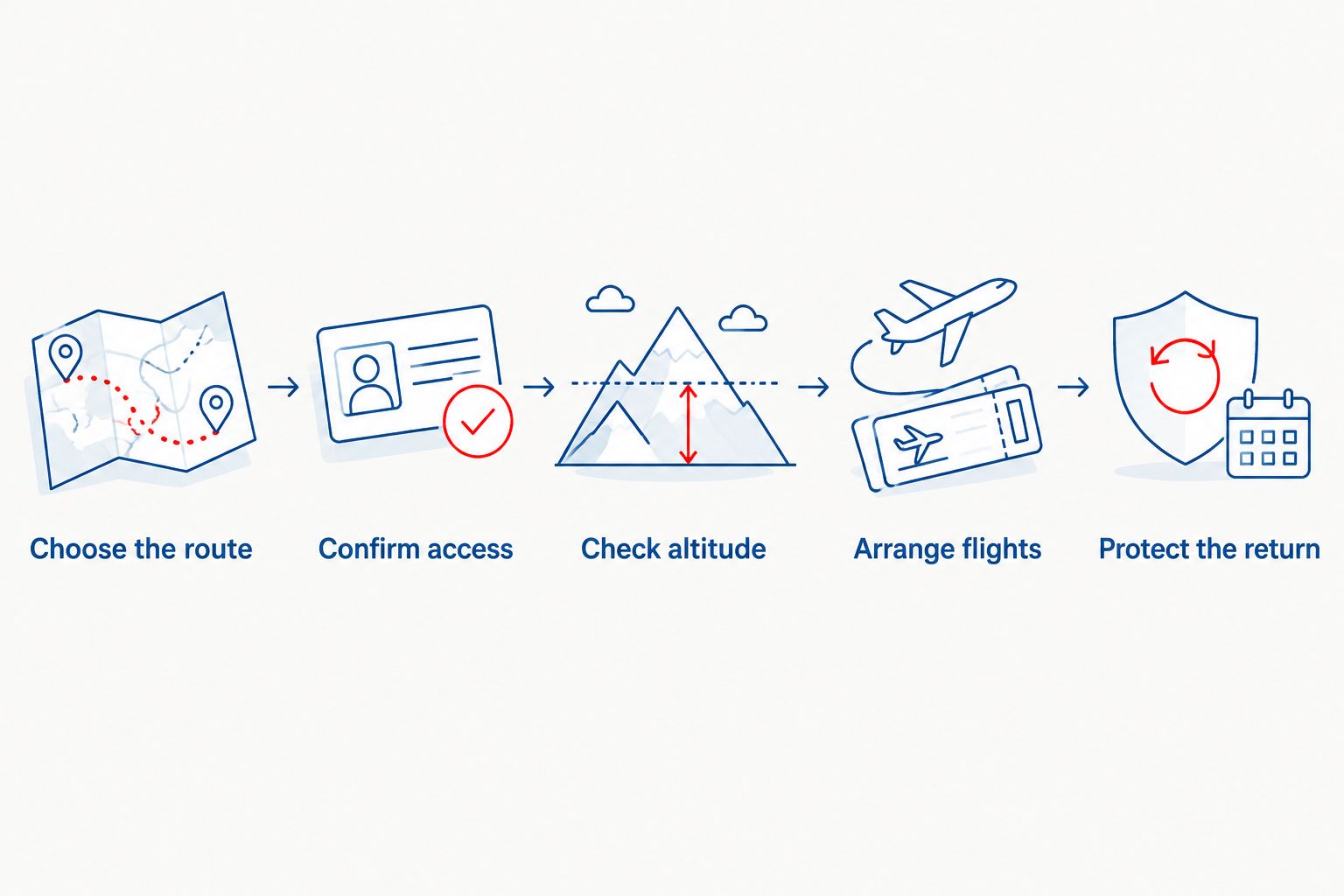
- Choose the route: Match the destination to your walking experience and preferred landscape.
- Confirm access: Check official travel advice, entry permission and the operator’s current route arrangements.
- Check altitude: Review sleeping elevations and acclimatisation before accepting the schedule.
- Arrange flights: Allow for the domestic journey and mountain-road transfers after international arrival.
- Protect the return: Leave a buffer between leaving the mountains and your international departure.
When comparing operators, request the day-by-day route, accommodation type, baggage arrangements and evacuation procedure in writing. Check whether your insurance covers trekking at the itinerary’s maximum altitude and whether evacuation terms match the proposed activity. Do not assume ordinary holiday cover includes it.
Use Contact Us to discuss flight and hotel arrangements once those trekking details are settled. Keep a copy of the operator’s meeting instructions with your travel documents.
Which Himalayan trek should you choose?
Choose Hampta Pass if you want the strongest all-round landscape contrast and are prepared for a high-pass trek. Sandakphu is the better fit when panoramas and lodge-based walking matter more than crossing a pass.
Choose Valley of Flowers for plants, Markha Valley for Ladakhi scenery, Goecha La for a demanding mountain-view approach, or Kashmir Great Lakes for a camping traverse centred on alpine lakes. For 2026, the right choice is the route whose requirements match your experience and available preparation time—not the one with the most dramatic photograph.
FAQ
What are the best Himalayan trekking destinations in India for a first trip?
Sandakphu and Valley of Flowers are the first options to assess if you want to avoid a remote high-pass traverse. Both still involve mountain walking and altitude, so compare the actual daily itinerary with your experience before booking.
Is Hampta Pass better than Sandakphu?
Hampta Pass is better for contrasting landscapes across a high pass; Sandakphu is better for panoramic mountain views and lodge-based itineraries. Choose according to terrain and accommodation preferences rather than treating either route as universally better.
When should I book a Himalayan trekking holiday in 2026?
Book your international travel after confirming the route’s operating season, meeting date and access requirements. Leave enough flexibility for acclimatisation, road transfers and disruption on the return journey.
Can I trek in the Himalayas without camping?
Yes, Sandakphu offers lodge-based itineraries, while Valley of Flowers visits use Ghangaria as a base. Some Markha Valley itineraries use homestays, but confirm every overnight arrangement with your operator.
Do New Zealand passport holders need special trekking permits?
Permit requirements depend on the destination, nationality and exact route. Check Indian entry requirements separately from national park permissions and protected-area requirements, particularly when considering Sikkim or border regions.
Does being fit prevent altitude sickness on an Indian Himalayan trek?
No, physical fitness does not prevent altitude sickness. Follow an appropriate acclimatisation schedule and seek medical advice about altitude exposure before travelling; worsening symptoms require prompt action rather than continuing upward.
Can Mann Travel NZ organise travel around my Himalayan trek?
Mann Travel NZ offers flight and hotel bookings for travellers in New Zealand. Provide your confirmed trekking dates and meeting point when discussing travel arrangements, and confirm guiding, permits and trekking logistics separately.
One last thing
The highest point is not the most useful number on a trekking itinerary. Ask where you sleep each night and how the route gains elevation between camps or lodges. That sequence tells you more about the acclimatisation plan than a headline pass height.
Before booking your 2026 journey, request those overnight locations in writing. If the schedule rushes the mountain approach to squeeze in more sightseeing, change the schedule rather than treating acclimatisation as spare time.
Related guides
- Best hill stations in India to escape the summer heat
- Best road trip routes in India for adventurous travellers
- Best winter destinations in India from December to February

