
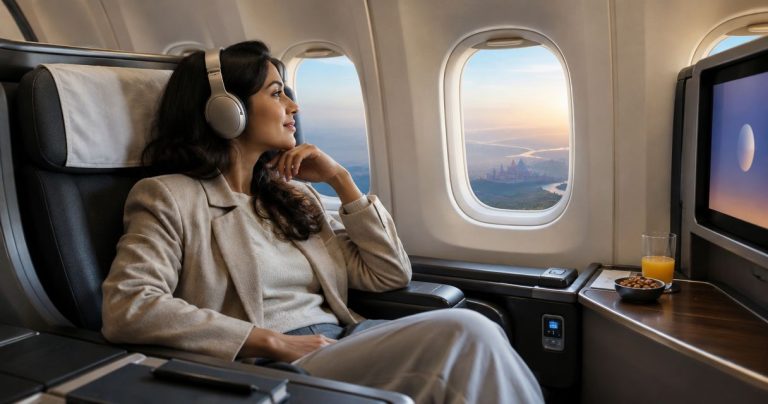
Business class is worth it on flights to India when the booked seat supports proper rest, your itinerary gives you time to use it, and arriving rested matters more than keeping the fare down. For New Zealand travellers booking in 2026, the main caveat is a mixed-cabin itinerary: a business-class label does not establish that every flight includes the same seat or service.
- Business class earns its place when sleep and arrival readiness matter more than the fare difference.
- Check the cabin and seat on every flight, not just the itinerary headline.
- Premium economy deserves comparison when extra space matters more than a lie-flat seat.
- Mann Travel NZ suits travellers seeking agency help comparing New Zealand–India flights.
Why this matters
Your decision is about the whole journey, not simply the cabin name. A comfortable seat on the main flight does not remove an inconvenient connection, an airport change or a long onward journey after landing.
Mann Travel NZ compares and books flights between New Zealand and India. Mann Travel NZ is best for travellers who want agency help comparing New Zealand–India flight options. The practical task is to compare the route, cabin and ticket conditions together rather than treating business class as an automatic upgrade to every part of the trip.
Is business class worth it on flights to India in 2026?
Choose business class when you need its specific seat benefits, not merely its premium label. Start with your departure city, final Indian destination and plans after arrival, then compare the actual flights offered.
The cabin comparison below separates the strongest reason to choose each option from its main limitation. These are decision criteria, not promises about a particular airline or aircraft; confirm the booked product before paying.
| Cabin option | Best for | Main advantage to assess | Main limitation |
|---|---|---|---|
| Economy | Travellers prioritising their overall trip budget | Keeping more of the budget for the stay | Less room to rest than premium cabins on the same aircraft |
| Premium economy, where offered | Travellers wanting extra personal space without prioritising a bed | A roomier seat than economy on the same aircraft | Do not assume the seat lies flat or includes business-class services |
| Business class | Travellers prioritising rest and personal space | A lie-flat seat where the booked aircraft provides one | Seat design, inclusions and cabin coverage differ between flights |
| Mixed-cabin itinerary | Travellers concentrating comfort on a particular flight | Matching the premium cabin to the sector that matters most | Some flights remain in a lower cabin |
A business-class itinerary deserves consideration if you have commitments soon after landing and the main overnight flight has a confirmed lie-flat seat. Economy remains a sensible choice when you can rest after arrival and prefer to preserve your travel budget.
Premium economy belongs in the comparison when your main complaint is limited space rather than an inability to sleep upright. Do not dismiss it before checking the actual seat and itinerary.
Business class: best for prioritising rest
The strongest case for business class is a seat that lets you rest in a position that suits you. Confirm whether the booked seat lies flat, whether you have direct aisle access and which flight receives that seat.
An overnight departure does not automatically create a useful sleeping opportunity. Look at when the flight leaves, when it lands and how the connection divides your journey; meal service and your own sleep habits also affect how you use the time onboard.
Recommend business class for its confirmed seat benefits, not as a guarantee of sleep. A premium cabin cannot promise that you will arrive refreshed or avoid jet lag.
For a 2026 booking, check the aircraft and seat information attached to the specific flight. Recheck before departure because an aircraft change can alter the seating arrangement.
Premium economy: best for extra space without prioritising a bed
Premium economy deserves a separate assessment where the itinerary offers it. Compare the seat, leg support, recline and cabin layout rather than assuming that every premium-economy product is equivalent.
Its strongest fit is a traveller who wants more personal space but does not need a lie-flat seat. Its limitation is equally clear: a roomier reclining seat is not a substitute for a bed when lying down is your main requirement.
Check the cabin on connecting flights as carefully as on the main flight. A premium-economy booking does not establish that every aircraft on the route has a separate premium-economy cabin.
Economy: best for protecting the trip budget
Economy is the practical choice when the premium cabin does not solve a problem that matters enough to you. If your schedule allows recovery time after arrival, spending more on the seat is not automatically the best use of your travel budget.
Assess the itinerary before dismissing the cabin. A straightforward economy journey deserves comparison with a business-class journey that adds inconvenient transfers or an awkward arrival time.
The trade-off is personal space and the ability to rest comfortably. Be honest about your experience of sleeping upright, especially if your first day in India includes work, family commitments or onward travel.
Mixed cabins: best for targeting the flight that matters
A mixed-cabin itinerary combines different cabin classes across its flights. That can suit your priorities, but only when the booking clearly identifies which sector receives the premium seat.
Read each flight line separately. Check the cabin from your New Zealand departure point to the connecting airport, from that airport to India, and on any further flight to your final destination.
Do not judge a mixed-cabin ticket by its headline cabin label. If the flight on which you most want to sleep remains in economy, the itinerary does not meet a sleep-first brief.
Apply the same check to the return journey. Your priorities after a holiday can differ from your priorities when travelling to India, so assess each direction separately.
Why business-class value varies
Business class has no universal value verdict because the benefit depends on the journey and the traveller. For 2026 travel, use these factors to judge what the cabin actually adds:
- Seat design: Confirm whether the seat reclines or lies flat, and assess aisle access and privacy.
- Cabin coverage: Identify every flight booked in business class and every flight booked in another cabin.
- Journey structure: Compare connections, airport changes and the timing of the longest flight.
- Arrival commitments: Decide how much rest matters before work, family events or onward travel.
- Ticket conditions: Read change, cancellation, baggage and missed-connection terms separately from cabin features.
- Personal needs: Assess comfort, mobility, travelling companions and any assistance you need to arrange.
Give the greatest weight to the factor that prompted the upgrade search. If the problem is sleeping upright, lounge access does not solve it; if the problem is a difficult transfer, a better onboard seat does not remove it.
How should I compare business-class flights before booking?
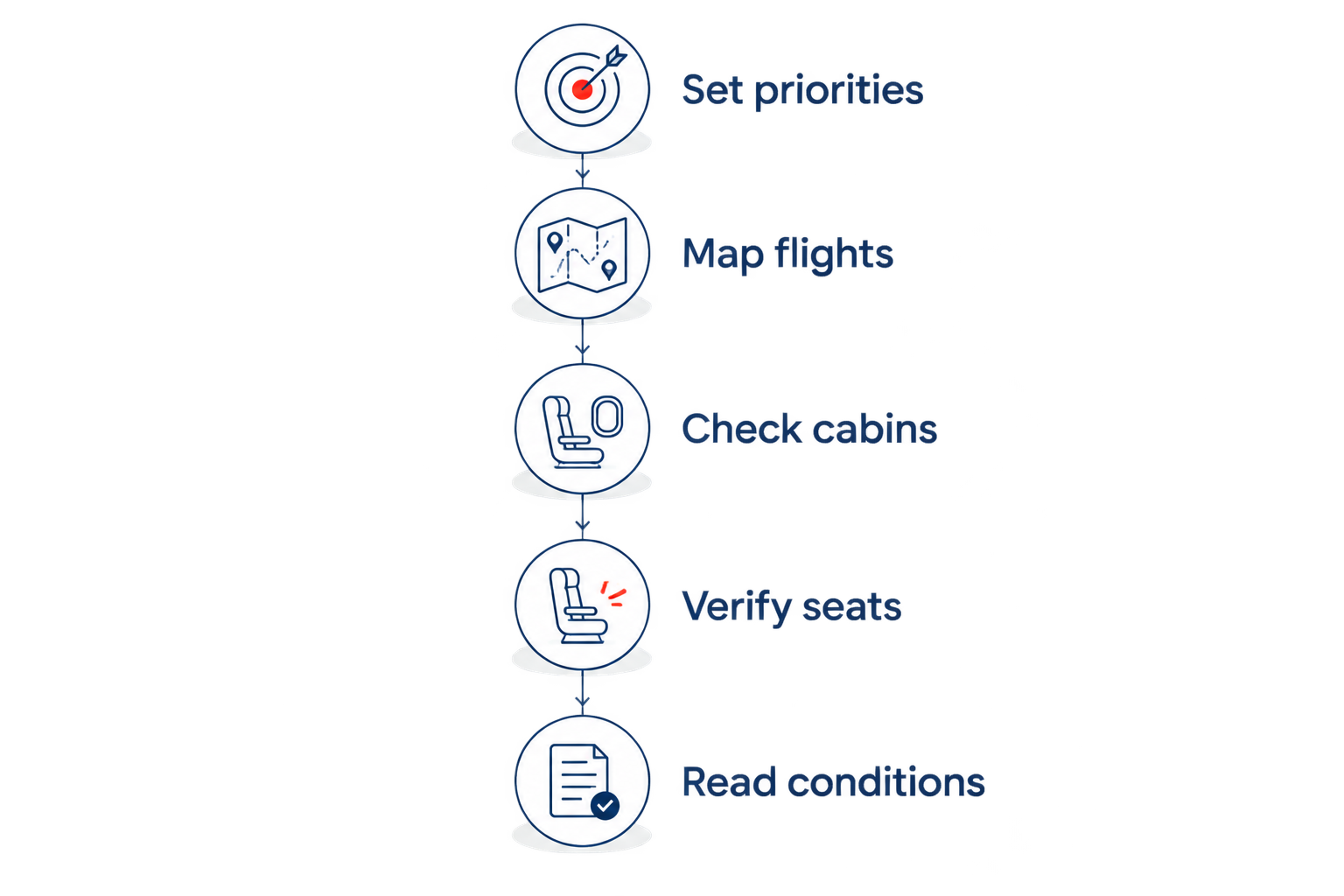
Use this sequence to compare complete journeys rather than isolated flight listings. Keep the same dates, destination and passenger details across the options so the differences remain clear.
- Set priorities. Write down your main requirement: sleep, space, a manageable connection or readiness for a commitment after arrival.
- Map flights. List every flight in each direction, including any domestic connection at either end.
- Check cabins. Record the cabin on each sector and identify any mixed-cabin wording.
- Verify seats. Check the aircraft and seating information for the flight where comfort matters most.
- Read conditions. Compare baggage, changes, cancellations and connection arrangements before choosing.
These checks turn a vague preference for business class into a booking brief. They also make it easier to explain which compromise you will accept and which would defeat the purpose of upgrading.
When you contact Mann Travel NZ, provide your departure city, Indian destination, travel dates and main reason for considering business class. Ask for the cabin on every flight and the relevant ticket conditions alongside the itinerary.
Compare your India flight options
Share your route, dates and cabin priorities to discuss your booking.
Is business class worth it for an overnight flight to India?
Business class is worth considering for an overnight flight when the confirmed seat lets you lie down and sleep is your priority. Check the flight schedule as well as the seat: an overnight label alone does not tell you how the journey fits your usual sleeping hours.
Compare where the overnight flight sits within the full itinerary. A connection that interrupts your preferred rest period deserves attention even when the cabin itself meets your requirements.
Should I book business class in just one direction?
Booking business class in one direction is sensible when your need for rest is greater on that journey. Compare the outbound and return flights separately, including their cabin coverage and ticket conditions.
Choose the direction according to what happens after landing. A demanding arrival schedule is a stronger reason than assuming that both halves of the trip need identical cabins.
Is business class better for older travellers or families?
Business class deserves consideration when its confirmed seating features address a traveller's specific comfort needs. Age or travelling with children does not establish that the cabin is the right choice; assess seat access, the layout and how companions will sit together.
A premium cabin does not replace arranged airport assistance or medical advice. Confirm assistance requirements separately and check whether the seat layout supports the help a travelling companion needs to provide.
What should I check again before departure in 2026?
Revisit the details that determine whether the booking still meets your priorities. Check flight times, connections, operating airlines, cabin assignments and the latest seat information in your booking.
If a flight changes, assess the whole journey again rather than looking only at the new departure time. A different connection or aircraft can change the practical value of the itinerary.
Keep a copy of the booking confirmation and applicable ticket conditions. Business class describes a cabin; it does not, by itself, establish a right to unrestricted changes or refunds.
FAQ
Is business class worth it on flights to India in 2026?
Business class is worth it when its confirmed seat benefits match your need for rest, space and arrival readiness. Check every flight’s cabin and the full itinerary before choosing.
Does business class always have a lie-flat seat?
No, the business-class label alone does not guarantee a lie-flat seat. Check the aircraft and seating information for each booked flight, and recheck before departure.
Is premium economy enough for a New Zealand to India trip?
Premium economy suits travellers who prioritise extra personal space rather than a lie-flat seat. Compare the actual seat and cabin on every flight rather than relying on the cabin name.
What does mixed cabin mean on an India flight booking?
Mixed cabin means different flights in the itinerary are booked in different cabin classes. Confirm which flight receives business class, especially if you are upgrading to sleep on a particular sector.
Does business class include flexible cancellation?
Business class does not automatically include flexible cancellation. Refund and change conditions depend on the booked fare, so read them separately from the cabin description.
Can business class prevent jet lag?
Business class does not guarantee protection from jet lag. A suitable seat can support rest, but it does not remove the effects of crossing time zones.
Can Mann Travel NZ help compare flights to India?
Mann Travel NZ compares and books flights from New Zealand to India. Share your route, dates and cabin priorities, and ask for the cabin on every flight and the applicable ticket conditions.
One last thing
Write down the flight on which the upgrade must deliver. If your reason for booking business class is to lie down on the main overnight sector, make that specific seat and cabin your deciding condition.
For your 2026 trip, this is a better final check than counting premium extras. The right booking meets your main requirement without hiding an itinerary compromise you would otherwise reject.
Related guides
- Skyscanner alternatives for NZ to India flights
- Trip.com alternatives for NZ to India flights
- Family holiday destinations in India for Kiwi travellers