
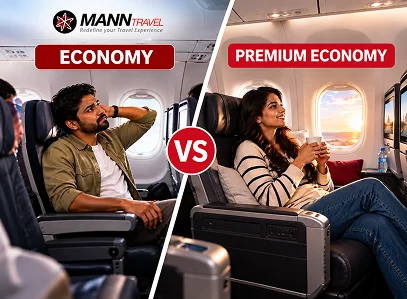
Upgrading from economy to premium economy typically costs an extra $500 to $800. But the real question is: is it worth the money? What are you actually getting — a slightly wider seat, a bit more legroom, better food — or just an expensive seat with a fancier name?
Let’s break it down: price, seats, baggage, food, and overall comfort. And by the end, you’ll know exactly when paying extra for premium economy actually makes sense.
What You Get in Economy
Economy is the airline’s standard, most budget-friendly cabin. You get a standard seat, in-flight meals, entertainment on applicable long-haul flights, cabin baggage, and checked baggage according to your fare.
For a short flight, economy is honestly perfectly fine. But when the flight stretches to 10, 12, or even 15 hours, the picture changes. Limited legroom, narrower seats, and restricted recline can make a long-haul journey genuinely exhausting — and by the time you land, your body might be asking for a bed before your holiday has even started.
Enter Premium Economy
Think of premium economy as the middle ground between economy and business class. You generally get wider seats, more legroom, better recline, and sometimes priority boarding, enhanced meals, and an additional baggage allowance.
It’s not business-class luxury, but it’s definitely more breathing space than economy — and on a long-haul flight, these small differences can actually be quite noticeable.
So How Much Extra Does It Cost?
The exact fare depends on the airline and travel dates. On long-haul routes — say, Australia to India or Australia to the UK — the price difference between economy and premium economy can run into hundreds of dollars. Sometimes premium economy costs around 30% more than economy. On peak dates or high-demand routes, that gap can climb to 70–80%.
So don’t upgrade just because someone says “premium economy is better.” Calculate the actual difference first.
Comfort: The Numbers Behind the Upgrade
Economy seats are generally around 17–18 inches wide, with a seat pitch of roughly 30–32 inches. Premium economy seats, on the other hand, tend to be about 18.5–20 inches wide, with a pitch of around 37–40 inches.
On paper, that might sound like just a couple of extra inches. But trust me — after 8 to 10 hours in the air, that extra legroom suddenly becomes your best friend. This matters even more if you’re tall, flying overnight, or hoping to actually sleep during the flight.
Does the Food and Service Difference Really Matter?
Economy typically offers standard meal service. Premium economy, depending on the airline, may come with enhanced meal options, better presentation, and a wider beverage selection. Service can also feel more personalized simply because the cabin is smaller.
But let’s be honest — you’re not booking premium economy just for better food. Comfort should be the biggest reason.
What About Baggage?
This is where premium economy can be surprisingly useful. Some airlines and fare types offer an additional checked baggage allowance for premium economy passengers. For example, economy might include one 23kg bag, while a particular premium economy fare could include two checked bags.
But here’s the catch: baggage allowance depends entirely on the airline and fare rules, so always check this before booking — especially if you’re traveling to India with gifts, shopping, or family luggage in tow.
The Final Verdict: Economy or Premium Economy?
Let’s keep it simple.
Choose economy if:
- The flight is relatively short
- Budget is your top priority
- You’d rather save money than pay for extra comfort
Consider premium economy if:
- The flight is 8–10+ hours
- You want extra legroom or better recline
- You’re on an overnight flight and want better sleep
- You’d like to arrive at your destination reasonably fresh
- The fare difference feels reasonable for what you’re getting
My Rule of Thumb
If it’s a long-haul flight and the premium economy upgrade is around 30–40% extra, I’ll seriously compare whether the benefits justify that price difference. But if economy is $1,200 and premium economy is $2,200, paying an extra $1,000 just for a wider seat isn’t sensible for every traveler.
Premium economy doesn’t automatically mean better value. It’s better value when the price difference matches the comfort you’re actually getting.
Premium economy isn’t a “cheap version” of business class — it’s a smart middle option for travelers who want more comfort without paying business-class prices.
Bottom line: Short flight? Save the money and take economy. Long overnight flight with a reasonable fare difference? Premium economy could be worth considering. Either way, do the math yourself — because the best flight isn’t necessarily the cheapest one. It’s the one that gives you the right balance of price, comfort, and travel time.
Comparing fares between economy, premium economy, and business class and not sure which offers the best value for your trip? Get in touch with a travel expert who can help you compare options and choose the itinerary that works best for you.
frequently asked questions
Is premium economy worth it compared to economy?
Premium economy can be worth it on long-haul flights when you value extra legroom, a wider seat and greater recline. However, it depends on the price difference, flight duration and the benefits included. If the upgrade costs significantly more, economy may offer better value for your trip.
What is the difference between economy and premium economy?
Economy is the standard cabin, while premium economy generally offers a wider seat, more legroom, greater recline and a separate cabin on aircraft that provide this class. Some fares also include enhanced meals, priority boarding or additional baggage. The exact benefits depend on the airline, aircraft and fare.
How much more expensive is premium economy than economy?
Premium economy can cost hundreds of dollars more than economy, but there is no fixed price difference. The gap changes with the route, travel dates, demand and remaining seats. Compare both fares for the same flight and calculate the extra amount before deciding.
Is premium economy worth it for long-haul flights?
It may be, particularly on overnight journeys lasting eight hours or more. Extra space and recline can make it easier to change position and rest. However, premium economy seats generally do not become fully flat beds, so the upgrade does not guarantee a good night’s sleep.
How much extra legroom do you get in premium economy?
Premium economy commonly offers around 5–7 inches more seat pitch than standard economy, although the difference varies by aircraft and cabin. Seat pitch measures the distance between corresponding points on successive seats; it is not the same as your usable legroom.
Does premium economy include extra baggage?
Some premium economy fares offer a higher checked baggage allowance than economy, but this is not guaranteed. Allowances depend on the airline, route and fare conditions. Check the permitted number of bags and weight limits before booking, especially if you are travelling internationally with gifts or extra luggage.
Is the food better in premium economy?
Premium economy may include an enhanced menu, different meal presentation or additional beverage choices. However, meal quality and service vary. If food is an important reason for upgrading, check what is actually included on your specific flight before paying extra.
Is premium economy the same as business class?
No. Premium economy is a step above economy, while business class generally offers a more substantial upgrade. On many long-haul aircraft, business class provides a lie-flat seat and additional airport services. Premium economy usually retains a reclining seat, so it should not be booked with the expectation of a business-class bed.

