
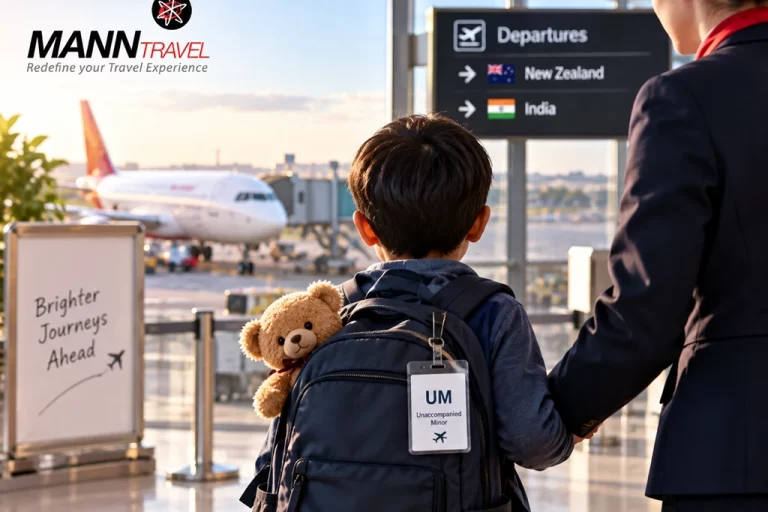
Children under 5 cannot fly without an accompanying adult. Children aged 5–11 travelling alone generally require Unaccompanied Minor (UM) Service, where airline staff supervise the child from check-in through to hand-off with a pre-registered adult at the destination. Teenagers aged 12–17 are usually treated as independent travellers, though optional supervision is often available on request. UM policies vary significantly between airlines, so it is worth checking the specific carrier’s rules before booking. Parents are advised to remain at the airport until departure and to arrive 2–3 hours early, particularly for long-haul New Zealand–India routes with transit stops.
Introduction
For many Indian families living in New Zealand, school holidays often mean sending children to India to visit grandparents, spend time with cousins, or attend family functions. When a child needs to travel without a parent, two questions tend to come up immediately: can the child fly solo, and how does the airline ensure their safety and support along the way?
This episode of Mann Travel Diaries looks at solo child travel between New Zealand and India, covering the relevant age rules, what Unaccompanied Minor Service involves, and what parents should keep in mind before booking a flight.
Age Rules for Solo Child Travel
Under 5 Years
Children under the age of five are not permitted to travel unaccompanied. Airlines require this age group to travel with a parent, guardian or airline-approved adult at all times.
5 to 11 Years
Children in this age bracket travelling without an adult are generally required to use the airline’s Unaccompanied Minor (UM) Service. This offers reassurance for parents, as airline staff assist the child throughout the journey — from check-in, through boarding and any transit stops, right up to arrival formalities.
At the destination, the child is handed over only to the specific adult whose details were registered with the airline in advance. Because of this, it is essential that receiving-adult information and the required paperwork are completed accurately at the time of booking.
It is also worth noting that UM policies differ from airline to airline. Some carriers provide excellent, well-structured supervision, while certain low-cost airlines may not permit younger children to travel solo at all. Reviewing the specific airline’s UM policy before booking is strongly recommended.
12 to 17 Years
Most airlines treat teenagers in this age group as independent travellers, meaning UM Service is generally not mandatory. That said, for a first international flight or where additional reassurance is preferred, many airlines offer optional supervision services on request.
A Key Responsibility for Parents
Once check-in is complete, parents or guardians should avoid leaving the airport immediately. Airlines recommend that a parent or guardian remain on-site until the aircraft has actually departed. This matters because flight delays, gate changes or additional verification requirements can arise, and the airline may need to contact the parent directly to resolve them.
Given that New Zealand–India routes are typically long-haul and often involve transit airports, arriving early on travel day is particularly important. As a general guideline, arriving 2 to 3 hours before departure allows sufficient time for check-in, baggage drop and documentation to be completed smoothly, reducing unnecessary stress on the day.
Quick Recap
- Under 5 years: Unaccompanied travel is not permitted.
- 5 to 11 years: Unaccompanied Minor (UM) Service is usually compulsory.
- 12 to 17 years: Most airlines allow independent travel without mandatory supervision.
- Parents/guardians should remain at the airport until the flight has departed.
- Arriving early — 2 to 3 hours ahead — is best practice.
Planning Solo Travel for a Child?
Whether arranging a New Zealand–India journey or the reverse, Mann Travel can help simplify the process from start to finish. From choosing the right airline and understanding UM Service requirements to comparing transit options and confirming the correct documentation, Mann Travel’s team supports parents at every step — giving peace of mind and ensuring the child’s journey is safe and comfortable.
Get in touch with Mann Travel to plan a child’s next India trip with confidence.
Stay tuned for the next episode of Mann Travel Diaries.
FAQ
Can a child travel alone from New Zealand to India?
Yes, depending on the child’s age and the airline’s policies. Younger children generally need Unaccompanied Minor (UM) Service, while older teenagers may be allowed to travel independently.
What age can a child travel alone on an international flight?
What is Unaccompanied Minor (UM) Service?
Do parents need to stay at the airport when a child is travelling alone?
How early should I arrive at the airport when a child is travelling alone?
For a long-haul New Zealand–India journey, arriving around 2–3 hours before departure is a useful guideline. Extra time allows for check-in, baggage, UM documentation and other required procedures.

