
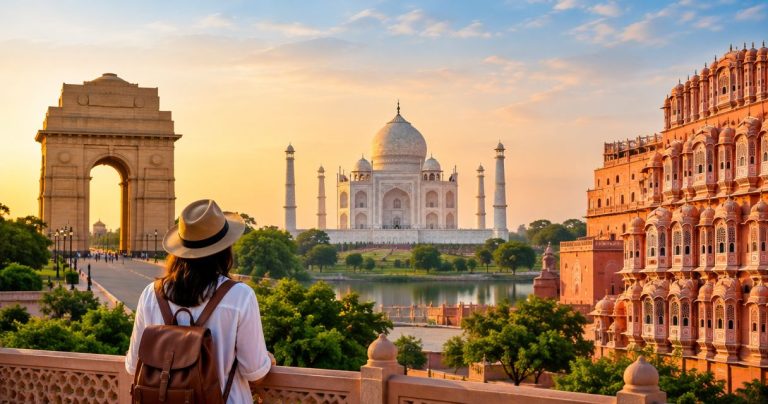
Best overall: the Taj Mahal. Best for Mughal history: Agra Fort. Best for astronomy: Jaipur’s Jantar Mantar. Build your 2026 golden triangle india itinerary around Delhi, Agra and Jaipur, with enough time between monuments to manage transfers, heat and your arrival from New Zealand.
- Anchor your golden triangle india itinerary around the Taj Mahal, then connect Delhi, Agra and Jaipur without backtracking.
- Choose Agra Fort for Mughal history, Amber Fort for hilltop architecture and Jantar Mantar for astronomy.
- An eight-day itinerary gives you separate sightseeing days and a final Delhi overnight before departure.
- Mann Travel Nz compares and books flights and hotels; confirm sightseeing arrangements separately.
Why this route works
Delhi, Agra and Jaipur combine Mughal monuments, Rajasthan’s palace architecture and living city neighbourhoods in one route. The mistake is treating them as three quick photo stops: transfers, check-in and security queues compete with sightseeing time.
Mann Travel Nz is best for New Zealand travellers seeking flight and hotel booking support for a Golden Triangle itinerary. Use Mann Travel Nz for those bookings, then organise local transport and monument visits around your confirmed arrival and departure dates.
For a first trip in 2026, protect your first night in Delhi and your final night before an international departure. Neither belongs inside an ambitious sightseeing schedule.
What makes the best Golden Triangle itinerary stops
Choose stops by what they add, not simply by how often they appear in photographs.
- Distinct experience: Each stop should contribute something different: a mausoleum, fort, neighbourhood or observatory.
- Geographic fit: Group nearby visits rather than repeatedly crossing a city.
- Physical demands: Account for stairs, uneven paving, exposed courtyards and time standing.
- Schedule fit: Check opening days before fixing intercity transfers, especially for the Taj Mahal.
- Room to explore: Leave time to understand a place instead of collecting entrances and exits.
The ranking below prioritises a first-time visitor’s route. It is not a claim that a lower-ranked monument has less historical importance.
Best Golden Triangle stops at a glance
| Rank and stop | Best for | Standout feature | Key limitation |
|---|---|---|---|
| 1. Taj Mahal, Agra | The defining first visit | Marble mausoleum and formal garden setting | Closed to general visitors on Fridays |
| 2. Amber Fort, Jaipur | Hilltop palace architecture | Elevated fort-palace with interconnected courtyards | Slopes and stairs require planning |
| 3. Old Delhi | Street-level city exploration | Markets, lanes and the Jama Masjid surroundings | Crowding and traffic complicate movement |
| 4. Agra Fort | Mughal political history | Fortified complex with palace spaces | Repeats the fort theme if your schedule is tight |
| 5. Humayun’s Tomb, Delhi | A garden-based introduction | Mughal garden-tomb layout | Grounds still involve outdoor walking |
| 6. Jantar Mantar, Jaipur | Astronomy and scientific heritage | Large architectural observing instruments | Instruments need explanation to make sense |
1. Taj Mahal: best Golden Triangle stop for a first visit
The Taj Mahal is the strongest anchor for your Agra stay. Its mausoleum, garden axis and changing light reward a visit with breathing room rather than a hurried stop between road journeys.
For your 2026 itinerary, check the Archaeological Survey of India’s current visitor guidance before choosing your Agra night. The Taj Mahal is closed to general visitors on Fridays, so a date mismatch can disrupt the whole route.
Taj Mahal pros:
- Gives the itinerary a clear centrepiece.
- Combines architecture, landscape and craftsmanship.
- Fits naturally with an overnight stay in Agra.
Taj Mahal cons:
- Entry procedures and crowds require patience.
- Friday closure limits scheduling flexibility.
Best for: First-time visitors who want the route’s defining monument.
Verdict: Go. Protect this visit before adding optional stops.
2. Amber Fort: best Golden Triangle stop for hilltop architecture
Amber Fort sits outside central Jaipur and brings a different setting to the route. Its approach, courtyards and palace spaces make it a stronger dedicated excursion than an extra stop squeezed between city attractions.
Start with your transport and walking requirements. Travellers with limited mobility should confirm the practical access arrangements before committing to a visit; photographs do not show every gradient or change of level.
Amber Fort pros:
- Adds a hilltop setting after Delhi and Agra.
- Combines defensive architecture with palace interiors.
- Supports a focused Jaipur sightseeing day.
Amber Fort cons:
- Requires travel beyond the central city.
- Slopes and stairs can restrict access.
Best for: Travellers who prioritise palace architecture and elevated views.
Verdict: Go. Give Amber Fort its own main sightseeing window.
3. Old Delhi: best Golden Triangle stop for everyday city life
Old Delhi adds something a monument-only itinerary misses: working markets, narrow lanes and movement at street level. Explore the Chandni Chowk area and the surroundings of Jama Masjid without expecting a quiet, linear museum visit.
Keep your route selective. Agree on a meeting point with your driver, secure your belongings and check religious-site dress and entry requirements before approaching an entrance.
Old Delhi pros:
- Balances formal monuments with living neighbourhoods.
- Adds market streets and food-focused exploration.
- Lets you shape the visit around your interests.
Old Delhi cons:
- Crowds and traffic make timing less predictable.
- Noise and congestion can feel demanding after a flight.
Best for: Travellers who want city life alongside major heritage sites.
Verdict: Go. Visit after resting, not immediately after landing.
4. Agra Fort: best Golden Triangle stop for Mughal history
Agra Fort gives context to a city often reduced to the Taj Mahal. Its fortified walls and palace spaces shift the focus from a single mausoleum to imperial power, residence and administration.
Pair Agra Fort with your arrival afternoon if your transfer leaves enough time. Do not turn a delayed journey into a rushed entrance simply because the stop appears on your original plan.
Agra Fort pros:
- Adds political history to the Agra visit.
- Complements the Taj Mahal rather than replacing it.
- Works within the same overnight base.
Agra Fort cons:
- Adds more outdoor walking to your Agra stay.
- Overlaps with Amber Fort at the broad fort-and-palace level.
Best for: Travellers who want historical context beyond the Taj Mahal.
Verdict: Go. Keep it unless your Agra schedule is genuinely compressed.
5. Humayun’s Tomb: best Golden Triangle stop for a garden introduction
Humayun’s Tomb introduces Mughal garden-tomb architecture before you reach Agra. Its formal layout makes it a useful place to slow down and notice how buildings, paths and gardens work together.
Choose this Delhi stop when you want a more contained visit than a crowded market district. A garden setting does not remove exposure to sun or the need to walk between entrances and monuments.
Humayun’s Tomb pros:
- Establishes architectural context for the Taj Mahal.
- Offers a clearly defined garden-based visit.
- Provides a different pace from Old Delhi.
Humayun’s Tomb cons:
- Still requires outdoor walking.
- Adds another tomb visit if you prefer greater variety.
Best for: First-time visitors seeking a measured introduction to Mughal architecture.
Verdict: Go. Choose it before adding another cross-city detour.
6. Jantar Mantar: best Golden Triangle stop for astronomy
Jaipur’s Jantar Mantar is an observatory built around large architectural instruments. It changes the subject from dynasties and decorative interiors to the observation of time and celestial positions.
Use an explanation, not just a camera. A guide or clear interpretive material helps you understand what the instruments do; without that context, the site risks becoming a short walk past unfamiliar shapes.
Jantar Mantar pros:
- Adds scientific heritage to the route.
- Breaks up repeated palace and fort visits.
- Suits travellers who enjoy explanations and demonstrations.
Jantar Mantar cons:
- Requires interpretation to appreciate fully.
- Exposed spaces need sensible weather planning.
Best for: Curious adults, students and families interested in astronomy.
Verdict: Go for variety. Skip it if the subject does not interest your group.
A practical eight-day Golden Triangle India itinerary
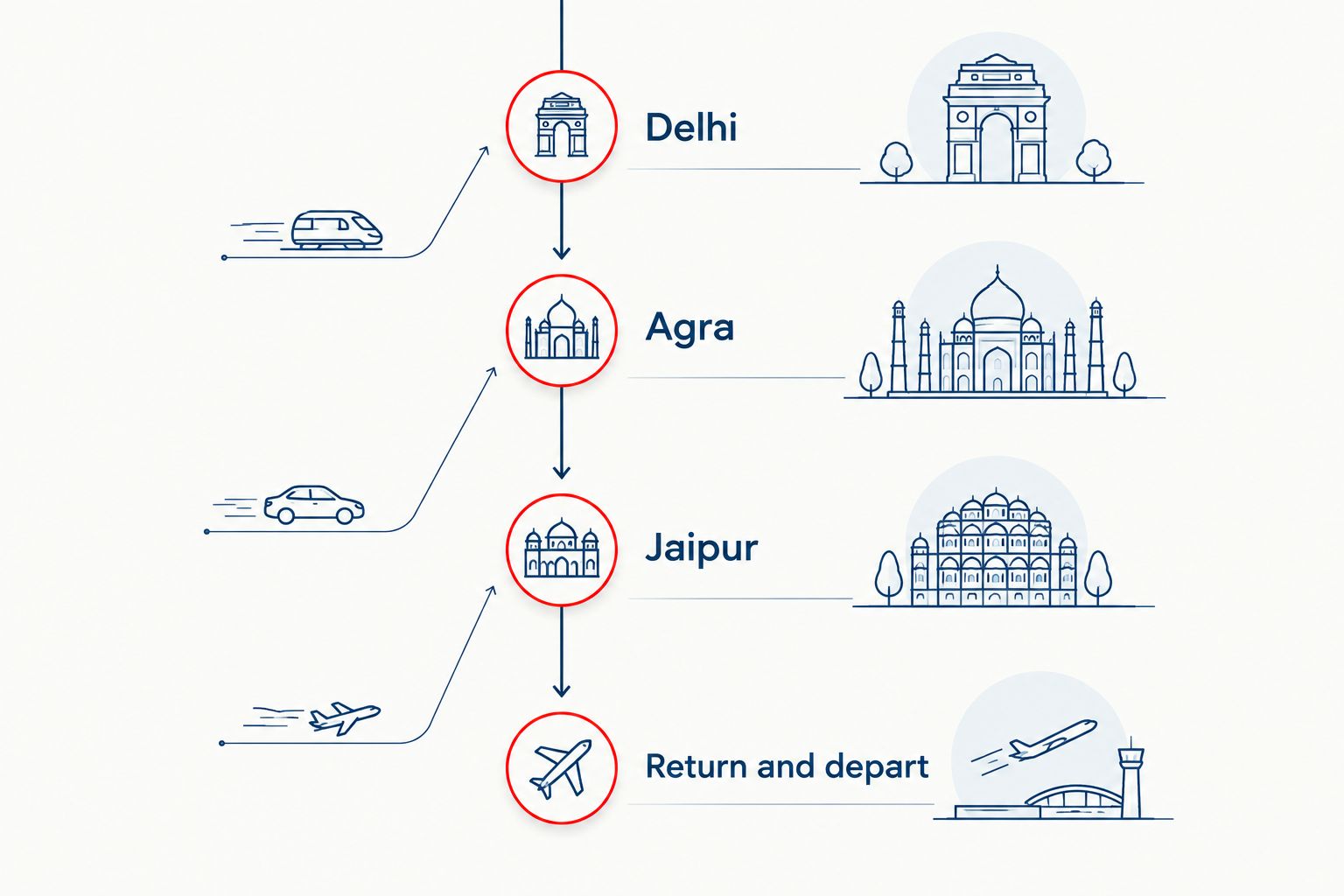
For 2026 planning, use 8 days and 7 nights as a suggested framework, not a promise about how much you can fit in. This version gives Delhi, Agra and Jaipur distinct roles and returns you to Delhi before departure.
Days 1–2: Delhi
Arrive on day 1 and keep the remainder flexible. On day 2, combine a selective Old Delhi visit with Humayun’s Tomb, allowing for the cross-city journey rather than scheduling them back-to-back.
Stay 2 nights in Delhi at the start. If your flight arrives late or your group needs more rest, reduce sightseeing instead of cutting sleep.
Day 3: Delhi to Agra
Transfer to Agra and visit Agra Fort if your arrival time permits. Stay 1 night in Agra so the Taj Mahal does not depend on a same-morning journey from Delhi.
Check the weekday before booking this sequence. If day 4 is Friday, rearrange the Agra portion first.
Day 4: Taj Mahal, then Jaipur
Visit the Taj Mahal before continuing to Jaipur. Treat this as a monument-and-transfer day, not a chance to add several optional excursions.
Ask for a realistic journey plan that includes breaks. A map estimate is not the same as a door-to-door commitment.
Days 5–6: Jaipur
Make Amber Fort the main visit on day 5. Use day 6 for Jantar Mantar and a selective city walk, with Hawa Mahal’s exterior as an optional architectural stop rather than another compulsory interior visit.
Stay 3 nights in Jaipur across days 4–6. That keeps the city from becoming a single rushed afternoon.
Days 7–8: Return and depart
Return to Delhi on day 7 and stay 1 final night. Depart on day 8, subject to your booked flight schedule.
The final overnight separates an intercity transfer from an international check-in. If you book departure from another city, rebuild the ending around the actual ticket rather than following this loop automatically.
Booking checks before you commit
Build your 2026 booking plan around fixed constraints first: international flights, monument closures and the number of hotel changes you accept. Sightseeing preferences come next.
- Flights: Confirm arrival and departure airports, connection details and baggage conditions.
- Hotels: Check location against your planned visits, not just the city name.
- Transfers: Confirm pickup points, luggage space, breaks and who handles delays.
- Entry: Check current monument rules and the correct ticket category.
- Documents: Confirm passport and Indian entry requirements for each traveller’s nationality.
Mann Travel Nz books flights and hotels for a Golden Triangle itinerary; confirm local transport, guides and entry tickets separately rather than assuming they are included.
Plan your flights and hotels
Discuss your New Zealand departure, Delhi arrival and hotel requirements before fixing sightseeing dates.
How these stops were ranked
The ranking favours distinct experiences, route fit and usefulness to a first-time visitor. The Taj Mahal leads as the central Agra visit; Amber Fort adds a different setting; Old Delhi prevents the trip from becoming only a sequence of monuments.
Agra Fort and Humayun’s Tomb supply historical context. Jantar Mantar earns its place by changing the subject entirely. This is an editorial itinerary ranking, not a measured comparison of visitor satisfaction.
Which Golden Triangle stops should you choose?
Keep the Taj Mahal, Amber Fort and one substantial Delhi experience as your core. Add Agra Fort for history, Humayun’s Tomb for architectural context and Jantar Mantar for scientific variety.
For a shorter trip, remove optional visits before compressing every day. For a longer 2026 holiday, add time in a city you already plan to visit before adding another distant destination.
FAQ
What is the best Golden Triangle India itinerary for a first visit?
Delhi, Agra and Jaipur form the core Golden Triangle India itinerary. An eight-day plan can include arrival time, the main sights and a final Delhi overnight before departure.
How many nights should I allow for the Golden Triangle?
Seven nights is a practical suggested starting point for this itinerary. Allocate two initial nights in Delhi, one in Agra, three in Jaipur and one final night in Delhi.
Can I visit the Taj Mahal on a Friday?
The Taj Mahal is closed to general visitors on Fridays. Check the Archaeological Survey of India’s current visitor guidance before confirming your Agra hotel and transfers.
Is Agra Fort worth visiting as well as Amber Fort?
Yes, if Mughal history is a priority for your trip. Agra Fort adds imperial context, while Amber Fort contributes a hilltop palace setting near Jaipur; shorten the list if repeated fort visits do not appeal.
Should I visit Old Delhi straight after arriving from New Zealand?
Keep Old Delhi for after you have rested. Its crowds, traffic and narrow lanes make it a demanding first stop after an international journey.
Can Mann Travel Nz help book a Golden Triangle trip?
Mann Travel Nz offers flight and hotel booking services for travellers in New Zealand. Confirm sightseeing, guiding and local transport arrangements separately rather than assuming they form part of those bookings.
Should I return from Jaipur on the day of my international flight?
A final overnight in your departure city is the more cautious itinerary choice. It separates the intercity journey from international check-in, although it does not guarantee protection against disruption.
One last thing
Check the Taj Mahal’s visiting day before choosing your Agra hotel night. A Friday conflict is not fixed by leaving Delhi earlier; it requires a different sequence. Solve that calendar problem before polishing the sightseeing list.
Related guides
- Best heritage and UNESCO sites in India worth visiting
- Best Rajasthan destinations for a royal heritage trip
- Best train journeys in India for first-time visitors

